Follow these tips from Arborjet’s Horticultural Specialist, Matt Andrus, to avoid salt damage to your plants. Andrus is a member of Arborjet’s research and development team, devoted to the discovery and development of the most effective equipment, formulations and application methods. What is deicing salt? “Many ice melt products are composed primarily of sodium chloride, […]
Read More
Monica Munoz, a member of Arborjet’s Marketing and Inside Sales team, shared her impressions of the Landscape Ontario Congress. The show is Canada’s premier horticultural event and was held at the Toronto Congress Centre recently, January 12th though January 14th. The show welcomed 13,000 attendees and over six hundred international exhibitors, including Arborjet. Fun Promoting […]
Read More
On December 09, 2015, Arborjet, Inc. earned the USDA Certified Biobased Product Label for its NutriRoot™ 2-2-3 Liquid Soil Applied Fertilizer. The USDA Certified Biobased Product Label verifies that the product’s amount of renewable biobased ingredients meets or exceeds levels set by USDA. Biobased products are finished or intermediate materials, composed in whole or in […]
Read More
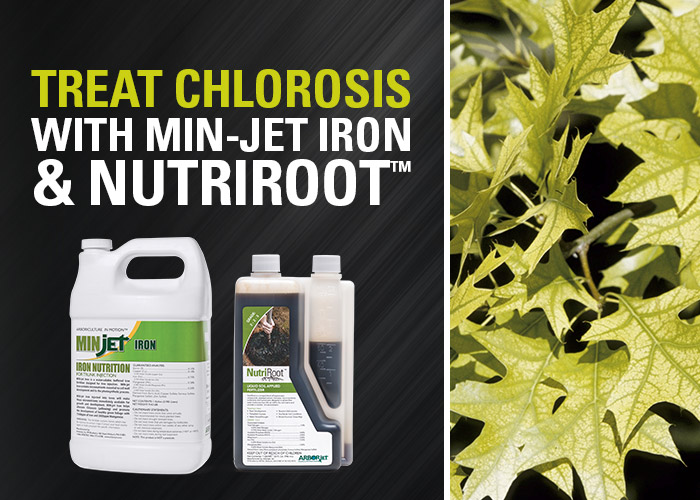
Iron or manganese chlorosis describes a condition in which a tree’s foliage loses its healthy green color and fades to a pale green or yellow hue. Without treatment, this condition will cause slow growth, leaf loss, and eventually tree death. Chlorosis is often caused by deficiencies of the micro-elements iron and manganese, and is particularly […]
Read More
Thrips are slender, tiny insects (generally 1 mm or less) that often have fringed wings. Nymphs lack wings, are elongate, and range in color from off-white or yellow to brown or black. Some common names for thrips include thunderbugs, storm flies, thunderblights, storm bugs, and corn lice. Most thrips feed by sucking out cell contents […]
Read More
Fire Blight is the most damaging bacterial disease that affects shrubs and trees in the Rosaceous family and occurs during warm spring weather when combined with rains or heavy dews. This disease is most often found in pear, apple, loquat and crabapple trees and has become a nuisance to homeowners and commercial landscape managers. Flower […]
Read More
There are several caterpillars that feed on oaks including the California oak worm and the tussock moth. Both of these feed on oak leaves, primarily in the spring, but can be active as second generation insects in the early summer or early fall. Leaves will appear skeletonized in the early stages and then completely consumed […]
Read More
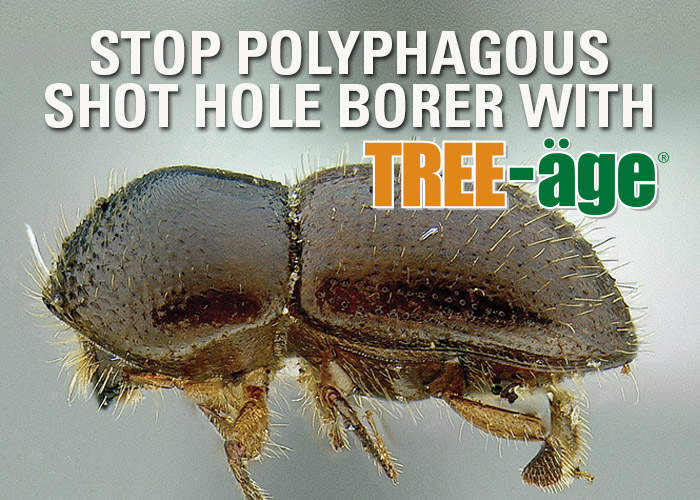
Polyphagous shot hole borer (PSHB) is an exotic ambrosia beetle that was first detected in 2003 in Southern California and only recently was found to be killing several species of trees. The “ambrosia” name refers to a symbiotic fungus that is carried by the female in special organs in her mouth parts. The fungus is […]
Read More
Kristin Nikodemski, Arborjet’s Product Marketing Manager recently shared her impressions from Max Yield’s 2015 Indoor Gardening Expo in Seattle. She revealed that everyone from Arborjet was pleased with the turn out and felt that it was a fantastic mixture of folks. The attendants came there for education and the level of interest was exciting. Instead of […]
Read More